As part of their third year Drama academic course, Contemporary Performance, students had to stage live art performances, public interventions or public installations in and around the campus community. The concepts for their pieces were provoked by what their seminar options were: Making from the self and surroundings, Re(imagining) Africa, or Butoh Dance. These performance art displays were performed at UCT’s Hiddingh Campus, on Thursday 25 March and Friday 26 March 2019.
THE PROCESS OF (UN)BECOMING
A piece staged by Lance-Selae August, Andy Harrison, Sam Jansen and Sam Alexander in a shady-looking dressing room located below the ground floor of the Little Theatre Extension Building, focused on the construction or deconstruction of identity. Identity was experimented and explored with through four similar yet different episodes. What is interesting about this piece is how the performers managed to confront the audience a problem statement through performing seemingly everyday rituals.
Andy questioned the deconstruction of a human being’s state of mind, and how memory is lost and regained, with forgetfulness starting to display a dominance in the human psyche with the onset of Alzheimer’s Disease. They creatively constructed the performance space with paper that illustrated writing and quotes specifically related to the brain, memory and forgetfulness. Walking through the space, one also found her laying in a bath of water, where bodily writings were being washed off. Sam Jansen explored the deconstruction of a notion that “to be Khoisan is the same as being Coloured”. Textures such as shards of broken beer bottles were scattered across the performance area, which forced the audience to confront stigmas related to Coloured lifestyle.
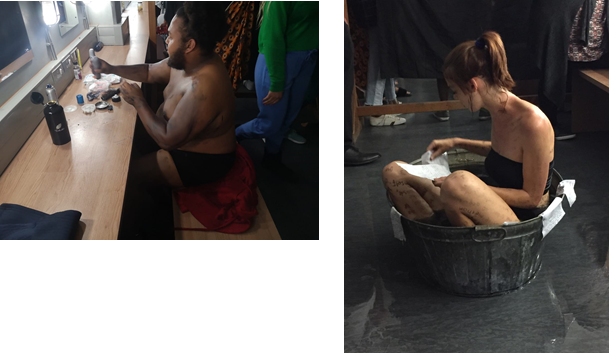
Another body in the performance space dealt with the construction of a bodily, racialized and sexualized identity through performing morning rituals of applying make-up, aerosol, black shoe polish, and women’s clothing. Similarly, Sam Alexander performed a poetic soundscape of problematic statements that male-identifying bodies say, alongside statements that the average individual makes to empower and motivate themselves, thus implying the verbal imparting of an identity.
A RACIST MEAL
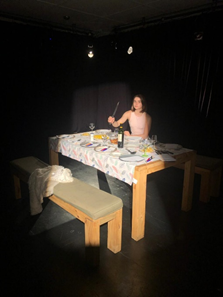
Another group staged a celebratory meal, where only White bodies could sit around the table. Audiences experienced aromas of good food, but also very problematic racist statements being made around the table. These racist utterings were taken from existing movie scripts. People of colour who were in the audience were given the power to throw the performers with water the moment a very problematic statement was said. The audience, with visible discomfort took control of the performance space by taking food from the table and drinking the wine. This reflected a form of reparation.
TAKING BULLETS FOR THE THEATRE
In a slightly more riskier piece, Guilio Beltramo, Tamzin Williams, Cullum McCormack and Ayden Croy staged a live-art intervention that aimed to test the extremes to which audiences would go when interacting with the performers. Picture four performers lined up against a wall of images, robed in white. In front of them are three tables of art equipment, each table holding a type of equipment more intense than the table that came before. The task was for audiences to use these items on the performer-body within a given time-frame. The tasks were to paint on them, followed by to throw them with water balloons filled with paint-stained water. The final task – the most extreme of all – was to shoot the performers with paintballs contained in a paintball gun.
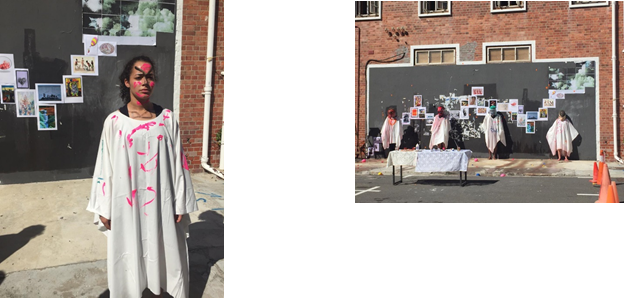
This performance was particularly interesting to the audience as it gave them the autonomy to decide how to engage with the performers. Many seemed to enjoy the first and second activity, as even I must admit, throwing water and painting somebody can be a fun activity. However with the paintball gun, many audience members backed away. There was one risk-taker, who was overcome by power and unleashed paintball pallets across the performers left, right and centre. Needless to say, the performers gained a bruise or five.
From the onset, what seemed like a game was meant to make an audience question how they perceive others. Questions such as “what identity do I paint others with?”, or “how much value do I attach to others” are questions that formulated in my brain. What was significant was how when faced with the power of holding a gun, the person who was shooting seemed to fully exert that power, which left performers and others in the space feeling very vulnerable.
ACTUAL AND IMAGINARY BORDERS
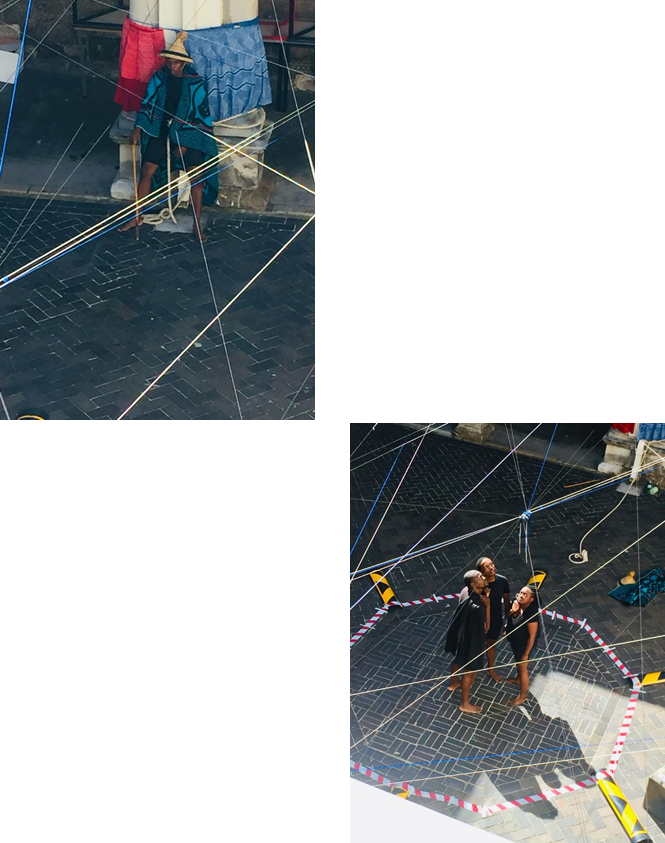
Tebatso Molapo, Elvis Sibeko and Mawande Mkhize performed a very pleasant and multifaceted piece which explored actual and imaginary borders in South Africa. The performance space was roofed by strings of wool, which to an extent aided the choreography of the performers. Each performer was also located within a particular place in the performance space, which resembled where they come from. In a nutshell, this performance art piece used a kaleidoscope of costume, soundscape, spoken word and choreography to make us see that borders can be both physical or imaginary. “We all have certain ways of interacting with each other, based on where we all come from”, says Tebatso. In the choreography, the performers make their way to the centre of the performance space, where they play with blazers and different ways of crossing a border, be it legally or illegally. Intersectionality is a prevalent theme in this piece, and it was shown through the intricate rope work, and the intricate soundscape which used overlapping sounds from Kwa-Zulu Natal, Lesotho and township life in Gauteng, to jam with what sounded like an interview where the notion of how Africans are perceived was interrogated.
Audiences who were observing these performances did not expect the discomfort and thought-provoking feelings that they were experiencing. The performance art pieces that I have chosen to place focus on all have an overlapping theme of identity. Live art is a very successful way to get individuals to question their identity, and that of others – and the third-years got it right!
 Performing/Performance Politics